The underground gambling world often makes the headlines in Turkey due to staggering cash flows and websites being blocked, just to come back under a different domain. But the illicit world of online gambling is not limited to just players. Propping up this expansive web — largely made up of young people — are workers in a variety of roles who often see their labor exploited. These illegal betting market workers provide live customer support, hand over their bank accounts to gambling sites to facilitate transactions, and recruit new account holders to integrate into the network. None of them ever meet face-to-face or know one another’s identities. Müzeyyen Yüce has written a comprehensive series reporting on the illegal gambling world in Turkey.
A night in the life of a live customer support worker
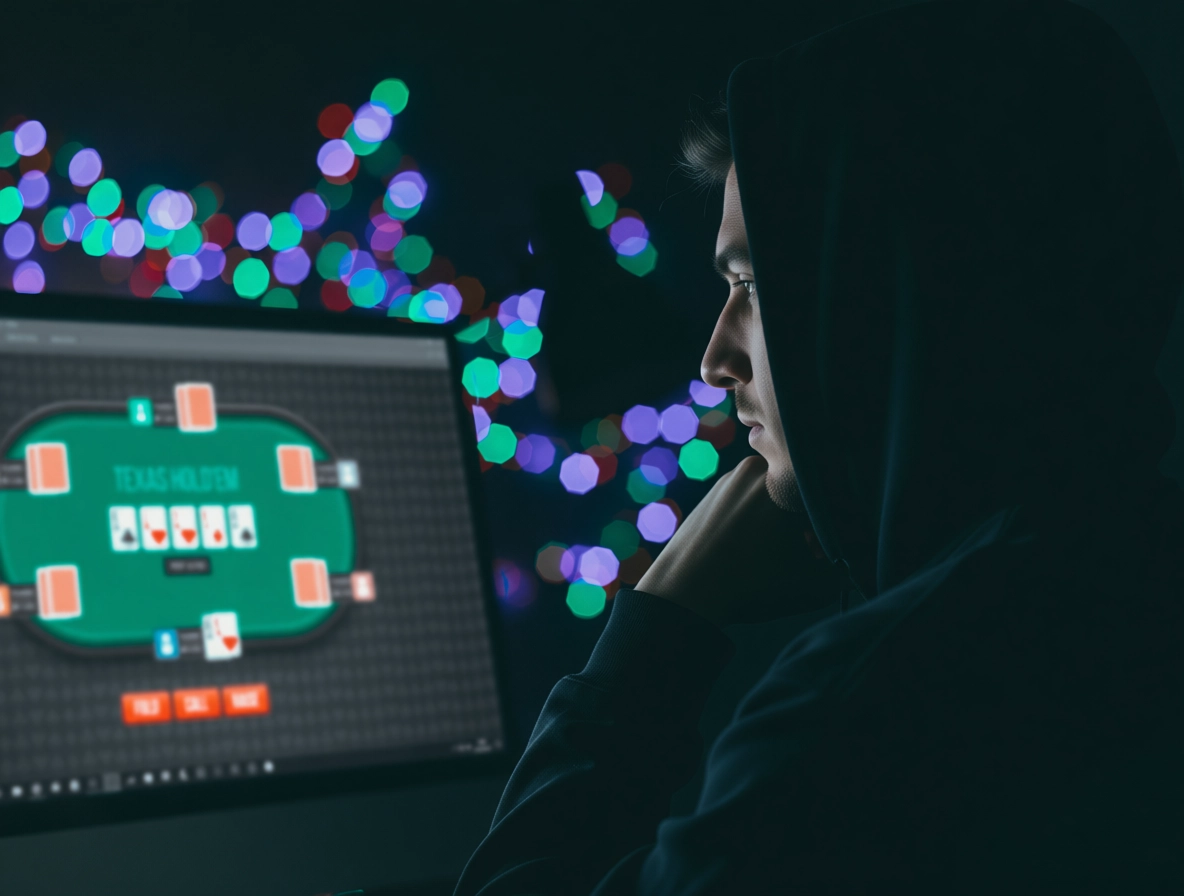
Ayaz sits in front of a laptop. As he types frantically, he keeps one eye on the conversation at the virtual table. The look of dissatisfaction on his face is hard to ignore. After watching him for a while, Yüce asks what he’s doing. Ayaz hesitates briefly and cautiously replies, “Why do you ask?” The players at the table chime in to ease his concern: “She’s no stranger,” they say.
That prompts him to start speaking, on the condition of anonymity. Ayaz says he works in the live support unit of an illegal gambling site. He spends nights responding to messages from players, handling everything from technical problems to players down on their luck asking for bonuses — essentially, credit to keep playing. Ayaz sends out automated messages while keeping up with the conversation.
Ayaz graduated in 2019 from a university in a small town in Anatolia, in Turkey’s interior. Despite months of job hunting, he came up empty-handed. When the Covid-19 pandemic hit, like everyone else, he was confined to his home.
As Ayaz spent more time at home, he likewise spent more time online. One day, a close friend pitched him a job opportunity: “I’m making three times the minimum wage. Want to try it?” Ayaz says, “Honestly, the money was tempting. I didn’t really have any other options at the time.”

No names, no faces, orders from above
Ayaz first went through a month of training. He never met anyone face-to-face; everything was handled remotely. After completing his training, he began working in “live customer support.” He logged in under any username and communicated with players through the chat. Ayaz says he never met anyone in management — no names were exchanged, no faces seen. Orders came from above, though to this day, Ayaz has never truly learned where “above” was.
Although it’s easy for anyone to access illegal gambling sites to play, Ayaz notes that the network is highly closed and secretive for those looking to join as employees. “You need a referral to get in. You can’t join otherwise. A friend of mine who worked there gave me a referral. No one on the site knows who anyone else is. Everyone has a username. The system is built on, and survives through, anonymity,” he says.
Ayaz spends most of his time in front of the screen. While most interactions are limited to technical support, every so often, extraordinary things break through the routine:
“Some players cry when they lose. Others ask for bonuses, saying, ‘I bet the last of my money, I’ve lost everything,’ or tell me how they spent their entire paycheck, took out loans, or borrowed from family.”
Ayaz recalls one particular interaction as the turning point in that settling-in period — the moment he says he began to be desensitized:
“A middle-aged man logged in one night. He had lost big. He wrote to me saying that he had lost all his money but just couldn’t break the habit. At first, I replied with automated messages. The rules are that you can’t remove a player from the live support system without very good cause. He kept writing, and eventually I felt sorry for him, so I replied. He told me his wife had left him because of his gambling, he had lost his job, and he was in a mountain of debt. We chatted for three hours. This isn’t typically allowed, but I suggested he stop playing at least until he could pay off his debts. He agreed and left the site. The very next day, however, I saw him playing again. Something changed in me that day. I stopped feeling guilty. It’s the players’ own choice, I thought. In a way, I had become desensitized.”

VIP players, million-dollar losses
Ayaz also says that not all players are treated the same in live support. Some players, known as “VIPs,” wager huge amounts. The identities of these players are shared with staff in advance, along with instructions to prioritize and expedite their transactions.
They play big — and lose big. Ayaz continues:
“There was a businessman. We would get a notification whenever he logged in. One night, I saw that he had lost 10 million. And he didn’t even flinch — he played every day. On one hand, you have players losing 200–300 thousand, crying over it; on the other, someone losing 10 million carries on as if nothing happened. It’s not just sports betting here. Most players are on roulette tables, slots, or instant-feedback games. I once saw someone log in just to try to win enough to pay his bill at a café.”
“I am neither innocent nor guilty”
When Yüce asked whether Ayaz feels at risk working in an illegal gambling network, he answered immediately, almost as if he had been expecting the question:
“Of course I feel it. But you also have to ask yourself: do I have any other options? If I left this job today and got another one, my take-home would automatically drop to minimum wage. I tried that once. There was a time I couldn’t take it anymore and left for a regular job. They paid just above minimum wage, and I worked 12-hour shifts. And even after all that, they said they were downsizing and laid people off anyway. I couldn’t find another job, so I came back here. No one leaves their dream job to come here. People come because they have no other choice. But still, it’s not work you’d want to do.”
By the time the conversation with Ayaz ends, his shift is over and he has logged off. He turns around with bloodshot eyes and says, ‘I am neither innocent nor guilty. I’m not forcing anyone to play. I’m just a small cog in a machine everyone is caught in. Even if I weren’t here, the wheel would keep turning.’

Bank accounts for rent
Much like Ayaz, Ömer first became involved in illegal gambling networks through sheer financial pressure. He was just 19, a university student, when he had his first encounter with illegal gambling. It happened right after high school, through his circle of close friends. He had not been able to get into the university of his choice, but still hoped to attend a private college. He was told, “You’ll rent your bank account to them and get paid.” Thinking he could earn money without leaning on his family, Ömer accepted the offer.
Ömer was initially contacted through Telegram and WhatsApp. A phone line and email were set up in his name, and he provided his bank account information. From that point on, he relinquished full control of his account to the gambling site operators. His account was used to facilitate payments from players. During the month it was in use, he was instructed not to make any transactions, and in exchange he received 8,000 Turkish lira.
15 bank accounts in a week
Ömer was offered 40,000 lira for each new bank account he could recruit. In just one week, he collected 15 accounts. He explained why the offer was so enticing and how he went about finding the accounts:
“At 18, I was full of energy. I thought I could raise money for college faster, so I said yes. I had no idea how serious a crime this was. I recruited my circle of friends — everyone wanted to do it. It seemed like easy money. I had tried it and nothing bad happened, so we would all convince others to do it too. Some people scammed others to get their accounts, but I never lied to anyone,” he said.
The accounts he collected were handed over to an intermediary. Ömer says it was at this point that he first realized there was a system and a hierarchy. “There are many intermediaries in this business,” he said. “I only ever saw the bottom layer. The person I gave the accounts to would pass them on to someone else, and that person would pass them further along. We never met the people at the top. The highest-ranking person I ever encountered was a dealer we knew as the site manager. I heard he reported to someone in Cyprus.”

“They have people at universities”
In a short period, Ömer earned between 700,000 and 800,000 lira. He says the gambling operations have people scouring university campuses, trying to recruit students one at a time:
“There are illegal gambling sites everywhere in Turkey. Almost no university student goes without being approached with an offer. In fact, just the other day, someone at a university stopped us and tried to recruit us,” he said.
What eventually made Ömer quit was a fraud incident. One of the people whose accounts he had collected for the network was scammed over a phone call:
“A friend got a call from someone claiming to be from the site, asking for his account password. He believed them and gave it to them. Of course, 100,000 liras deposited by players had vanished from the account. The site operators then called us, demanding the money. When it became clear we had been scammed, we were told to provide two more accounts to cover the loss. We couldn’t find anyone in the first week and got into a difficult situation. We managed to secure the accounts the following week but that became the time I first realized how dangerous this work exactly was,” he said.
“I was threatened when I tried to quit”
“I worked there less than two months,” Ömer says. When he tried to quit, the network threatened and intimidated him. Ömer blocked their numbers on Telegram and WhatsApp and moved to Istanbul to attend a private university. He now tries his best to make a living working at a café.
But Ömer’s past hasn’t quite let him go. Ömer was recently called in for questioning by the police due to suspicious activity on his bank account:
“I’m scared. I worry I could go to prison or be expelled from school. A friend whose account I handled is also under investigation. Looking back, I realize I made a huge mistake. We thought it was easy money, but it’s not easy at all. Most of us didn’t even know this was such a serious crime. Anyone with sense wouldn’t get involved in this work,” he said.
Müzeyyen Yüce
Müzeyyen Yüce graduated from Akdeniz University with a degree in Public Relations and Communications. She began her journalism career in 2013 as an intern at DHA and later reported for Antalya Körfez Gazetesi, Gazete Duvar, and Artı Gerçek. She currently works as a freelance reporter.
About the project
The European Union funds the “Support for Media Freedom – Strong Solidarity, Strong Media” project, run by the Journalists’ Union of Turkey (TGS), the Journalists’ Association (GC), and the İzmir Journalists’ Association (IGC). The program aims to strengthen media diversity and support a free press in Turkey.
Translated and edited by Medyascope English Newsroom