Turkey’s central bank (TCMB) recently announced record losses of 818.2 billion Turkish Liras for 2023. Economists who spoke to Birgün newspaper attributed the losses to the central bank’s protected deposit policy, instituted in late 2021 to slow soaring inflation of the Lira.

Protected deposit payments
Turkey has suffered persistent inflation since 2018. December 2021 saw a notable crisis when the Turkish Lira plunged from around 12 to the US Dollar to 18 in a matter of weeks, driven in part by successive lowering of interest rates at Turkey’s central bank.
At the time, President Recep Tayyip Erdoğan defended the unorthodox decision to lower interest rates, arguing that high interest rates were forbidden in Islam, as well as putting forward the belief that lower interest rates would lead to increased exportation, which would in turn tame inflation. The Turkish Central Bank began cutting interest rates from 20%, down to 6%; leading the Lira to suffer historic crashes each time the rate was cut.
On December 20, 2021, with the Lira in free-fall, Erdoğan announced emergency measures aimed at reversing the currency’s rapid devaluation. The measures were successful in restoring the Lira’s value against the Dollar from 18.3 to 12.3 in a matter of hours, but were criticized by economists who saw the measures as short sighted and presenting long-term risk.
The emergency measures introduced a ‘protected deposit’ system, encouraging citizens to retain their funds in Liras rather than converting them into foreign currency. Through this system, funds could be placed in designated savings accounts safeguarded against future devaluation, with the government compensating depositors for any losses incurred due to currency devaluation.
In other words, Turkey’s central bank promised to compensate citizens using these accounts in the event of future loss of value in the Lira.
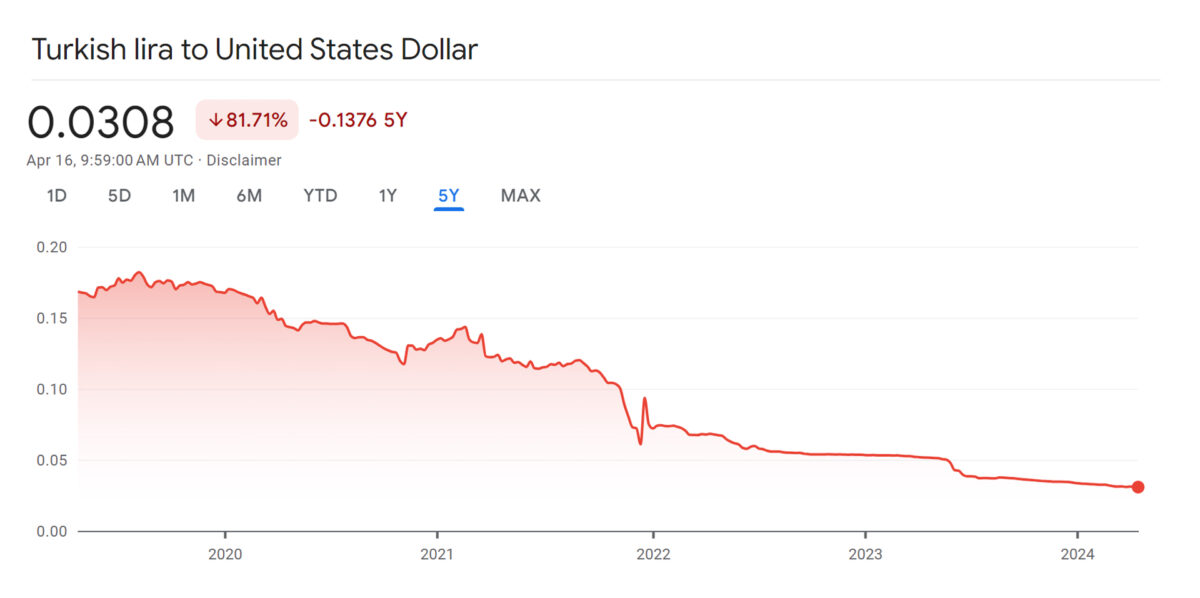
While the measures were successful in temporarily restoring the Lira’s losses, the currency has since continued to devalue to around 32 to the Dollar.
Former Central Bank Chief Economists Prof. Dr. Hakan Kara who spoke to Birgün described the measures as ‘the world’s most expensive economic experiment’.
Following Erdoğan’s reelection in May 2023, Turkey’s central bank hiked interest rates for the first time in 27 months as part of a promised return to economic orthodoxy, which included the hiring of Hafize Gaye Erkan as Central Bank Minister and Mehmet Şimşek as Minister of Finance.

Retirees and low earners expected to bear the brunt
Prior to Turkey’s local elections on March 31, Erdoğan controversially announced that pensioner payments would not receive a hike, arguing that any increase would not be possible ‘even if all other payments are halted’.
Erdoğan’s Justice and Development Party (AKP)’s poor showing in the polls was blamed in part on retirees not turning out to vote, instead staying home and penalizing the ruling party for soaring costs of living and a failure to hike pensioner checks. Main opposition Republican People’s Party (CHP) emerged victorious, winning a plurality of votes for the first time since 1977.
Economists evaluating the central bank’s record reported losses said retirees and low-earners have borne the brunt of the ‘protected deposits’ system, as austerity measures aimed at taming inflation have ruled out any benefit hikes for these groups.
Written/translated for Medyascope by Leo Kendrick