
ERCAN, TRCN (Medyascope) — Turkey has formally deployed six F-16 fighter aircraft and advanced air defense systems to Northern Cyprus, marking a significant escalation in the military footprint on the divided island as conflict spreads across the Middle East.
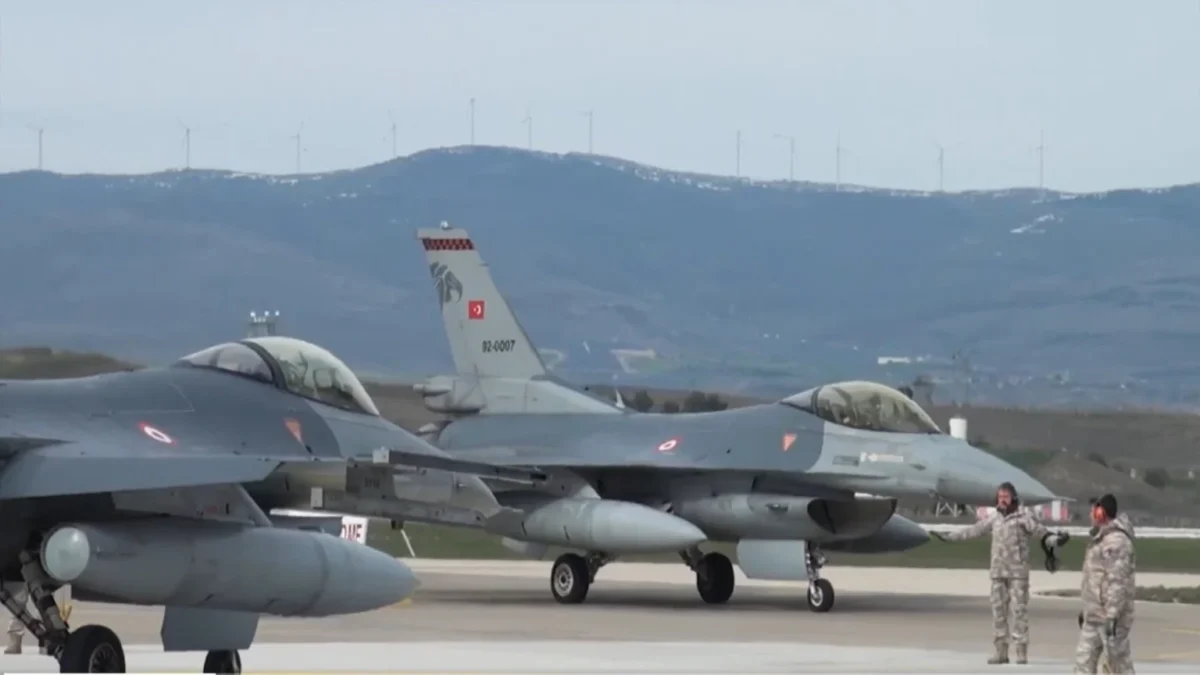
The supersonic jets arrived at Ercan Airport on Monday morning, touching down at 09:30 local time. According to officials from the Turkish Ministry of National Defense, the aircraft were “fully armed and ready for immediate operations.”
The move follows ten days of intensive military strikes by the United States and Israel against Iran, a campaign that has rapidly drawn in regional neighbors and Mediterranean territories. While Turkey has maintained a precarious neutrality in the direct fighting, the deployment signals Ankara’s determination to shield its interests on the island.
A phased security plan
In a statement, the Turkish Defense Ministry described the arrival of the Fighting Falcons as part of a “phased security planning” initiated in response to recent regional developments.
“Additional measures will continue to be taken based on further developments, if deemed necessary,” the ministry added.
The deployment appears to be a direct “tit-for-tat” response to recent maneuvers by Athens. Last week, Greece—a fellow NATO member but a long-standing regional rival to Turkey—deployed four of its own F-16V jets and two naval frigates to the Republic of Cyprus (the southern, Greek-speaking part of the island) to bolster its defenses.
The Iranian shadow
The immediate catalyst for the deployment appears to be the spillover from the U.S.-Israeli war with Iran. On March 8, Iran launched drone and missile strikes targeting the British Sovereign Base Areas of Akrotiri and Dhekelia in southern Cyprus. Tehran claimed these bases were being used as “springboards” for Western strikes against Iranian nuclear sites.
Turkey has already felt the effects of the war. In recent days, NATO air-defence systems intercepted ballistic missiles believed to have originated from Iran and heading toward Turkish airspace. Debris from one intercepted missile reportedly fell near the southern city of Gaziantep, though no casualties were reported.
The escalating regional crisis has prompted several countries to reinforce military positions across the Eastern Mediterranean. France, for example, has announced plans to send warships to the Red Sea, while NATO allies have strengthened missile-defence systems in Turkey.
The Cyprus conundrum
The arrival of Turkish jets in Cyprus is more than a simple border reinforcement; it touches a raw nerve in European diplomacy.
Cyprus has been partitioned since 1974, following a Turkish invasion triggered by a brief Greek-backed coup. The island is split by a UN-monitored “Green Line.” The southern Republic of Cyprus is an EU member and is recognized internationally as the sole legitimate government. In contrast, the Turkish Republic of Northern Cyprus (TRNC), where the F-16s are now based, is recognized only by Ankara.While Turkey maintains a permanent garrison of roughly 30,000 troops in the north, it has historically avoided basing permanent fighter jet squadrons there to avoid inflaming tensions with the West. Monday’s move effectively moves the goalposts on that policy.
Turkey deploys F-16 fighter jets to Northern Cyprus as regional tensions rise | Writtentranslated by Medyascope English Newsroom